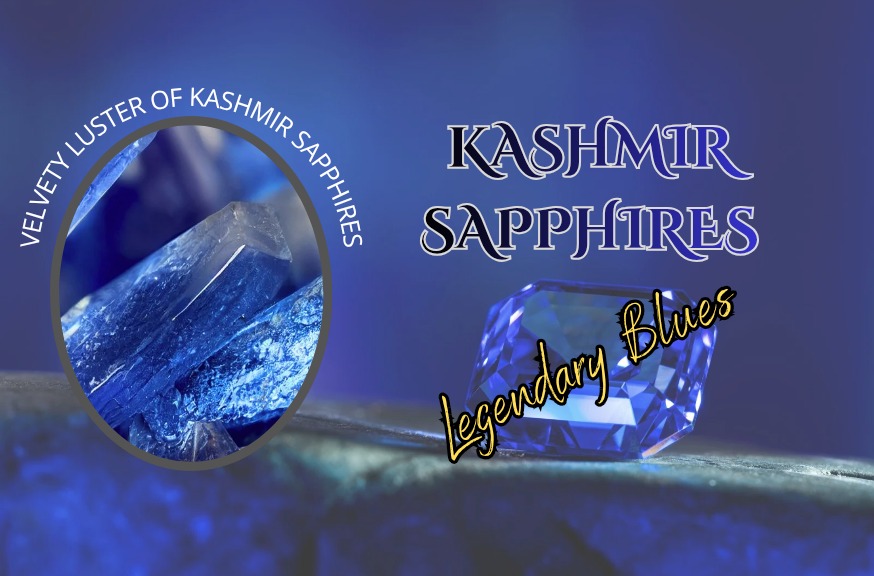
Kashmir blue sapphires are regarded as some of the most exquisite gemstones ever discovered. Their legendary status in the gem world comes from two extraordinary visual qualities: a velvety luster and a deep, royal blue color. These characteristics not only make Kashmir sapphires highly desirable among collectors but also serve as key indicators used by respected gemological laboratories such as GIA (Gemological Institute of America) and Gübelin to identify a true Kashmir origin. Understanding how these gems attain their signature appearance involves exploring geology, inclusions, microstructure, and the unique environmental conditions of the Kashmir mines.
KASHMIR SAPPHIRES VELVETY LUSTER
The velvety luster for which Kashmir sapphires are famous is primarily the result of microscopic inclusions known as silk. This silk is composed of extremely fine rutile particles that formed naturally during the sapphire’s growth deep within the Himalayan mountains. These fine needles scatter light in a soft, diffused manner, giving the sapphire its velvety glow. The distribution of rutile in Kashmir sapphires is typically very fine and evenly dispersed, contributing to the classic “sleepy” or velvety effect that experts praise. Gemologists at laboratories like GIA and Gübelin frequently rely on the distinct nature of this silk as one of the diagnostic features when determining Kashmir origin.
KASHMIR SAPPHIRES ROYAL BLUE
The royal blue color of Kashmir sapphires comes from trace amounts of iron and titanium in the crystal lattice of corundum (aluminum oxide). The geological environment of the Kashmir mines—extreme heat, pressure, and a unique balance of trace elements—created ideal conditions for producing sapphires with an intense yet soothing blue hue. Unlike sapphires from many other regions, which may require heat treatment to enhance color, Kashmir sapphires often show exceptional natural color. Their rich, saturated blue combined with the softening effect of natural silk makes the hue appear almost three-dimensional. This color profile is so distinctive that it remains one of the primary identifiers used by gem testing institutions when evaluating Kashmir sapphire claims.
BIGGEST KASHMIR SAPPHIRES
Among the Kashmir sapphires that exemplify these characteristics, two large and magnificent gems stand out: The Spirit Of Kashmir and the Zanskar Crown sapphire. Both gemstones originate from the legendary Kashmir mines, which were active primarily during the late 19th and early 20th centuries.
The Spirit Of Kashmir
The Spirit Of Kashmir sapphire is renowned for its remarkable size and flawless display of the velvety blue coloration typical of the finest stones from this region. Collectors and historians frequently refer to the Spirit Of Kashmir as an emblem of the unparalleled beauty that these mines once produced. The Spirit of Kashmir Sapphire is officially recognized by Guinness World Records as the largest Kashmir sapphire, weighing 150.13 carats (30.026 g). Cut as a cushion, it measures 29.19 × 25.09 × 21.72 mm and remains completely natural and untreated.
According to Guinness, the sapphire is owned by Goldiama LLC (UAE) as of 10 November 2023.
Zanskar Crown Sapphire
The Zanskar Crown sapphire is another remarkable gem, celebrated for its impressive weight and the unmistakable Kashmir color tone. Like the Spirit Of Kashmir, the Zanskar Crown sapphire demonstrates how large Kashmir stones retain superior blue saturation and surface luster even at significant sizes—a trait not commonly found in sapphires from other origins. The presence of fine rutile silk in the Zanskar Crown sapphire further enhances its velvety texture, making it a prime example of classical Kashmir aesthetics.
The Zanskar Crown Sapphire is a legendary Kashmir blue sapphire shrouded in mystery and royal prestige. Reports estimate its cut weight to be between 170 and 220 carats, some accounts suggest the original rough stone may have been as large as 450–570 carats. The cushion cut sapphire is linked to the Maharajas of Kashmir—first acquired by Maharaja Ranbir Singh and later inherited by his successor, Maharaja Pratap Singh. It was apparently Maharaja Pratap Singh who set the stone into an elaborate royal necklace, naming it the “Zanskar Crown.” Facing financial pressures, he is said to have sold the sapphire in the early 1920s, using the proceeds to fund his ambitious development projects in Kashmir—improving infrastructure, education, and public health.
Both the Spirit Of Kashmir and the Zanskar Crown have gained attention among gem connoisseurs because they showcase the peak qualities that define Kashmir sapphires. These rare gems reinforce the understanding that origin is a crucial aspect of sapphire valuation. Once a testing laboratory confirms Kashmir origin—based on inclusions, trace elements, growth zoning, and overall visual features—other factors such as clarity or even minor inclusions become less significant. In fact, gem enthusiasts often appreciate the presence of characteristic silk in Kashmir sapphires, as it plays an essential role in creating their signature velvety look.
KASHMIR SAPPHIRES RARITY
The rarity of Kashmir sapphires today makes stones like the Spirit Of Kashmir and the Zanskar Crown even more significant. The mines that produced these extraordinary gems have been largely inactive for decades, and only a limited number of top-quality stones remain available on the global market. As a result, any sapphire displaying the saturated royal blue color and velvety luster typical of Kashmir demands close study by laboratories such as GIA and Gübelin. The unmistakable features of Kashmir origin, including finely distributed silk and specific spectral and chemical signatures, allow these labs to authenticate the gems with confidence.
QUICK NOTES
In conclusion, the velvety luster and royal blue color of Kashmir sapphires arise from a rare geological combination of trace elements, natural silk inclusions, and unique Himalayan formation conditions. These visual traits have become the hallmark of Kashmir origin and remain central to laboratory identification. Legendary stones such as the Spirit Of Kashmir and the Zanskar Crown continue to exemplify the grandeur of these gems, serving as shining reminders of why Kashmir blue sapphires are revered as some of the most beautiful gemstones ever discovered.